


What astronomical opportunities did Russia take away from Ukraine by occupying and annexing Crimea? What research was conducted on the peninsula during Soviet times and after Ukraine regained independence? Which international projects were Crimean scientists and research infrastructure involved in? All this and more was discussed by a member of the Presidium of the National Academy of Sciences of Ukraine, director of the Main Astronomical Observatory of the NAS of Ukraine, academician Yaroslav Yatskiv, in an interview with the online publication "Crimea.Realities" – the Crimean project of the Ukrainian service of Radio Liberty.
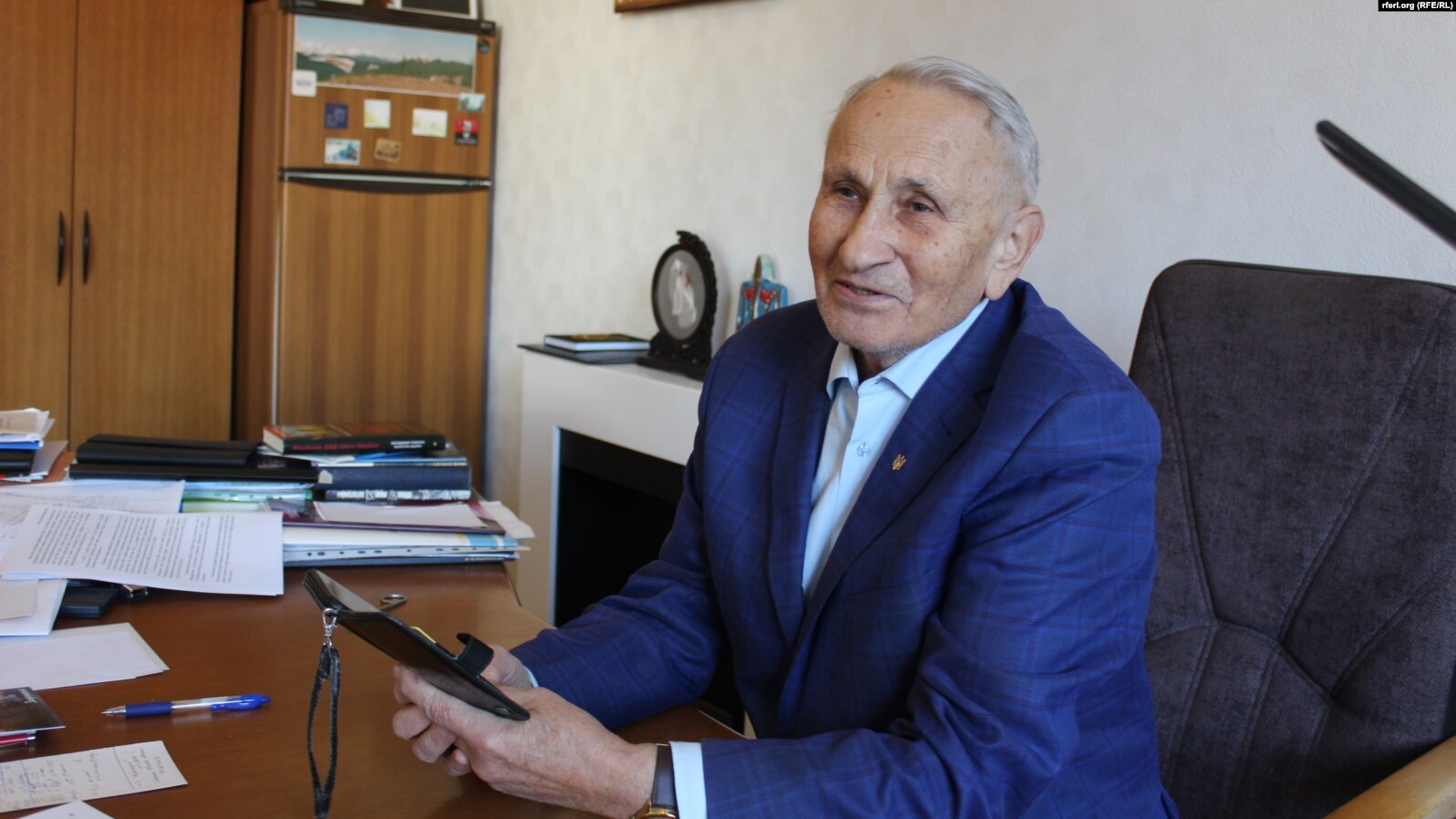
Academician Yaroslav Yatskiv. Photo by Rudolf Medved ("Crimea. Realities")
The Crimean Astrophysical Observatory (CrAO) was founded in a location with excellent astroclimate, the scientist recalls: "In Europe, for example, such [normal] conditions [for observations] exist on the Canary Islands, in the United States – in Hawaii. <…> And so the Crimean Astrophysical Observatory (CrAO) was established there near Bakhchisarai in the mountains. At that time, in the Soviet Union, it was the largest observatory with a wonderful astroclimate: a significant number of clear nights, which characterize the observatory, and the largest telescope in the Union at that time named after Shain with a diameter of 2.6 meters. <…> We [that is, the Main Astronomical Observatory of the NAS of Ukraine in Kyiv] had constant contacts with CrAO. <…> Obviously, CrAO was not engaged only in optical research methods, because astronomy was gaining the status of multi-wavelength. Then it was decided to engage in radio astronomy, and a site was chosen in Simeiz, a telescope was brought there, and an observatory was built. This telescope of Soviet production, RT-22, with a "dish" (parabolic reflector antenna – Ed.) 22 meters in diameter. And this radio telescope began to be used for radio astronomical observations. This was still during Soviet times..."
After regaining independence, Ukraine began to develop astronomy and space research in Crimea. "...since 1991 a new era began. The Crimean Laser Station (KLO), which we established there instead of the laser station of the P.N. Lebedev Physical Institute [of the USSR Academy of Sciences], under the leadership of Yuriy Kokurin, was transferred under the jurisdiction of the MAO NASU [Main Astronomical Observatory of the NAS of Ukraine] in Kyiv," says academician Yaroslav Yatskiv. "From the position of KLO, we started laser satellite observations, because we did not reach the Moon's location: we did not have such capabilities in our optical production. This station is still marked as Ukrainian, it operates, providing research results under international programs, as does our laser station here in Holosiiv. They are part of the International Laser Ranging Service (ILRS). Those who worked there remained after 2014. But they do not have the right to publish in international journals as representatives of the Russian Federation. And this is a kind of compromise rule that operates worldwide: they write that they represent KLO in Crimea, which is considered Ukrainian worldwide, and that's it. So, in no professional publication can you find publications by astronomers from Crimea representing the Russian Federation. But despite everything, as far as I know, there are many scientists on the occupied peninsula who have at least somewhat remained loyal to Ukraine."
About the RT-22 telescope stolen by Russia, Yaroslav Yatskiv said that this instrument "was equipped by NASA to be included in the International Very Long Baseline Interferometry Service (VLBI). Colleagues from the USA installed everything there: equipment, hydrogen frequency standards, receivers, and other equipment. And this instrument was included in the global network. <…> RT-22 in the international VLBI network does not work today. Two laser stations that worked in Ukrainian Crimea before – one on Mount Kishka (Simeiz station) does not work, and the second station in Katsiveli works normally. I do not know the reasons why the station on Mount Kishka does not work. We can monitor their work through the results of international information services: both the number of observations, the number of involved people, and the accuracy of observations. The research results of Crimean authors are currently not published in our journals issued by MAO, we publish in co-authorship those Crimeans who returned to the mainland."
As the scientist noted, Russia deprived Ukraine of the opportunity to conduct research not only in Crimea but also on the territory of the Russian Federation itself, namely at the Terskol peak in the Caucasus Mountains, where a Ukrainian observatory previously operated: "Despite all the difficult circumstances and Russia's war in Ukraine, the land and property in Terskol are ours, Ukrainian. Moscow declared that Terskol is now Russian. The FSB categorically forbade Ukrainian astronomers from traveling there, and our friends who remained there until a certain time from performing any programs for us. The same applies to Crimea, where we cannot officially carry out any programs. But despite everything, we receive some research results without disclosing how we do it... True, they are no longer as extensive and large as before..."
At the same time, academician Yaroslav Yatskiv is certain that Russia, like any empire of the past, will eventually collapse, and Ukraine will restore its territorial integrity and scientific capabilities in the temporarily occupied territories by the enemy.